Leaked RTX 5090 Prototype Reveals Extreme Power Ambitions and Bold Engineering Design
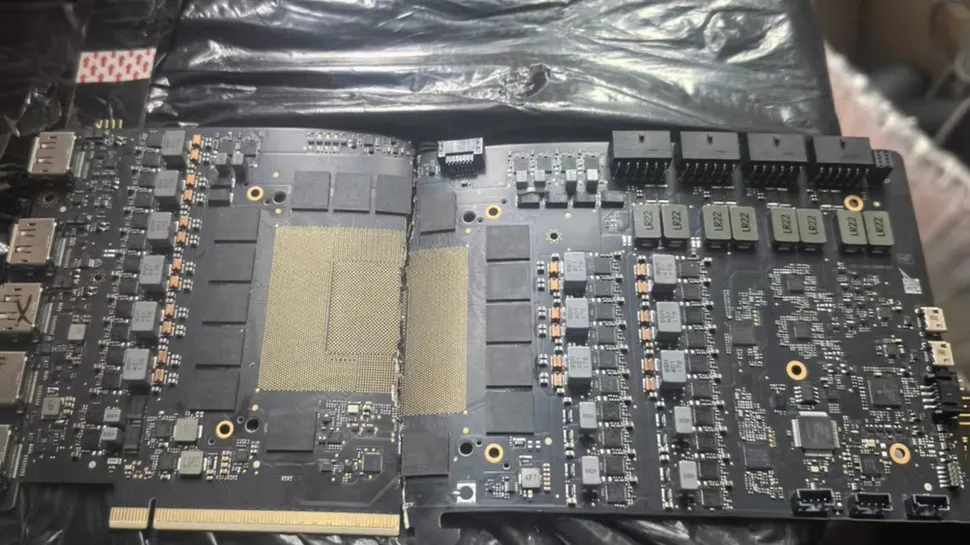
A surprising development in the GPU world has emerged as a leaked image of what appears to be a prototype of NVIDIA’s upcoming RTX 5090 graphics card has surfaced online. Shared by @yuuki_ans on Twitter/X, the image shows an engineering sample featuring a staggering four 16-pin power connectors and an unusually heavy VRM layout—suggesting NVIDIA may have once considered pushing the GPU to previously unthinkable power limits.
Four Power Connectors: A Glimpse Into a 2,400W Beast?
The prototype, which has been visibly cut in half (presumably to destroy or repurpose the card), reveals design choices that are anything but standard. The presence of four 16-pin power connectors raises eyebrows, as each 16-pin (12VHPWR) connector can technically deliver up to 600 watts. Combined, this setup could theoretically draw as much as 2,400 watts—an absurd amount of power typically associated with high-end industrial equipment or small home appliances, not a consumer graphics card.
The purpose of this configuration could be multi-faceted. On one hand, it might have been implemented as a redundancy feature—ensuring stable operation even if one or more connectors failed. On the other, such a setup could be intended to spread the power load across multiple inputs to avoid thermal hotspots and stress on individual power lines. This could indicate that NVIDIA was exploring ways to safely push the GPU’s capabilities to the limit.
VRM Overload and Niche Targeting
To support this potential power draw, the card features two symmetrical rows of voltage regulator modules (VRMs) adjacent to the GPU die mount—another clue that this wasn’t meant for standard gaming use. A VRM-heavy design like this would be required to deliver clean, stable power across such a large draw, potentially pointing to usage scenarios like AI workloads, high-performance computing (HPC), and complex visual effects (VFX) simulations. These are fields where power and performance take precedence over energy efficiency or noise levels.
Additional Design Elements Suggest Early Testing Phase
Closer inspection of the board reveals even more unique features. Additional headers and diagnostic pins are located along the PCB’s edges, alongside fan and USB connections. There’s even a fifth video output port—one more than the typical four seen on modern GPUs. These unusual inclusions suggest this unit was built for internal testing rather than end-user deployment.
The memory modules visible on the prototype are similar to what’s expected in the RTX 5090, though it’s unclear if extra memory is present on the reverse side of the PCB. If so, this could be an early version of a more powerful variant—possibly an RTX 5090 Ti or even a member of NVIDIA’s next-gen Blackwell-based “RTX PRO 6000” series.
A Pattern of Extreme Engineering
This isn’t the first time we’ve seen radical RTX 5090 prototypes. A January leak revealed another engineering sample featuring dual 16-pin power connectors and a thermal design power (TDP) of 800 watts—39% higher than the 575W rating expected for the consumer RTX 5090. That prototype featured 24,576 CUDA cores (up from 21,760 in the production model), higher clock speeds, and a 512-bit memory bus carrying 32GB of GDDR7.
NVIDIA itself briefly teased a massive quad-slot Founders Edition version of the 5090 with a vertical PCB and triple-fan “three-thirds flow-through” cooling in a behind-the-scenes video. Though the design was never released, it demonstrated the kind of extremes NVIDIA was experimenting with before finalizing the consumer-ready product.
Final Thoughts
While this prototype will never see store shelves, its discovery provides a fascinating look into NVIDIA’s design and testing process. The four 16-pin connectors and dense VRM layout paint a picture of a GPU that may have been more than just powerful—it was a technological statement piece. As the RTX 5090 inches closer to launch, it’s clear that NVIDIA is prepared to break boundaries not only in gaming but across the wider landscape of high-performance computing.